Hidden Sector Online › Forums › General › Extended Game FAQ › 1. The game › 5. How a battle works
- This topic is empty.
-
AuthorPosts
-
September 27, 2026 at 6:20 pm #723
DigiFalk
Architect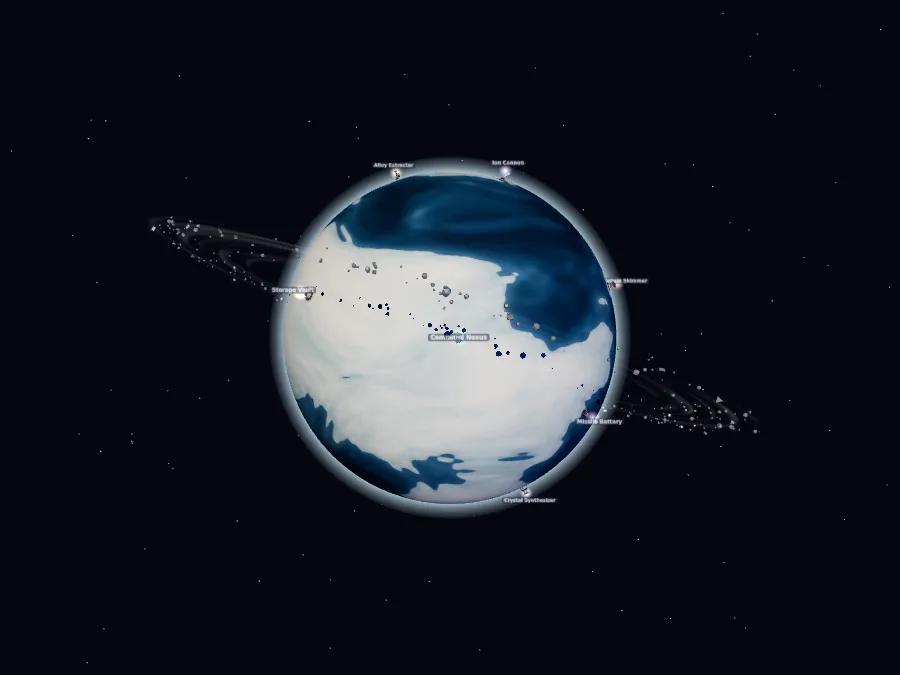
After a large engagement: a debris ring waiting for recyclers.A raid is fought in two phases: first the orbital clash, then – if you won the sky and brought marines – a ground assault for the planet itself. The two lines exchange fire over 6 rounds.
Each round costs a side in proportion to how far the other side outguns it. That is a ratio rather than a share of a combined total, which has a specific consequence: an overwhelming fleet wipes what it meets in one round instead of running into a floor that always leaves a remnant alive, and the side with greater firepower always comes out of the exchange ahead.
Losses are applied between rounds, so an advantage compounds: every hull you destroy in round one is a gun that never fires at you in round two.
The defender's ground defences stand in the line as units of their own, and so does any fleet stationed there by an ally.
Rapid fire is the whole game
Some hulls get several shots for one against a particular class of target, and that rapid fire counts for as much of the enemy line as is actually made of that class. Sixty Battle Cruisers and six hundred Corvettes cost roughly the same to build: send the cruisers against the swarm and they annihilate it while barely losing a hull; send the swarm the other way and it is wiped out to the last ship. What you bring matters more than how much of it you bring – which is why scouting is worth the Probe.
Reading the report
A battle report gives you the whole line of battle rather than a total: a table per side, a row per hull type, showing what stood in the line when the shooting started, what survived, what it cost, and how many of that hull were still standing at the end of every round. It is the difference between knowing you lost eight bombers and knowing they died in the second round, before they ever reached the wall.
Before any of it, the fleet panel carries a battle simulator. It runs the same arithmetic the real battle does, so the projection is exact – and it flies with your crews aboard, so veterancy is included. What it cannot know is what the enemy actually has.
-
AuthorPosts
- You must be logged in to reply to this topic.